The Bottleneck
Machines can now plan, reason, and act. But every decision rests on what their sensors can resolve — and perception, not intelligence, is now the limit.
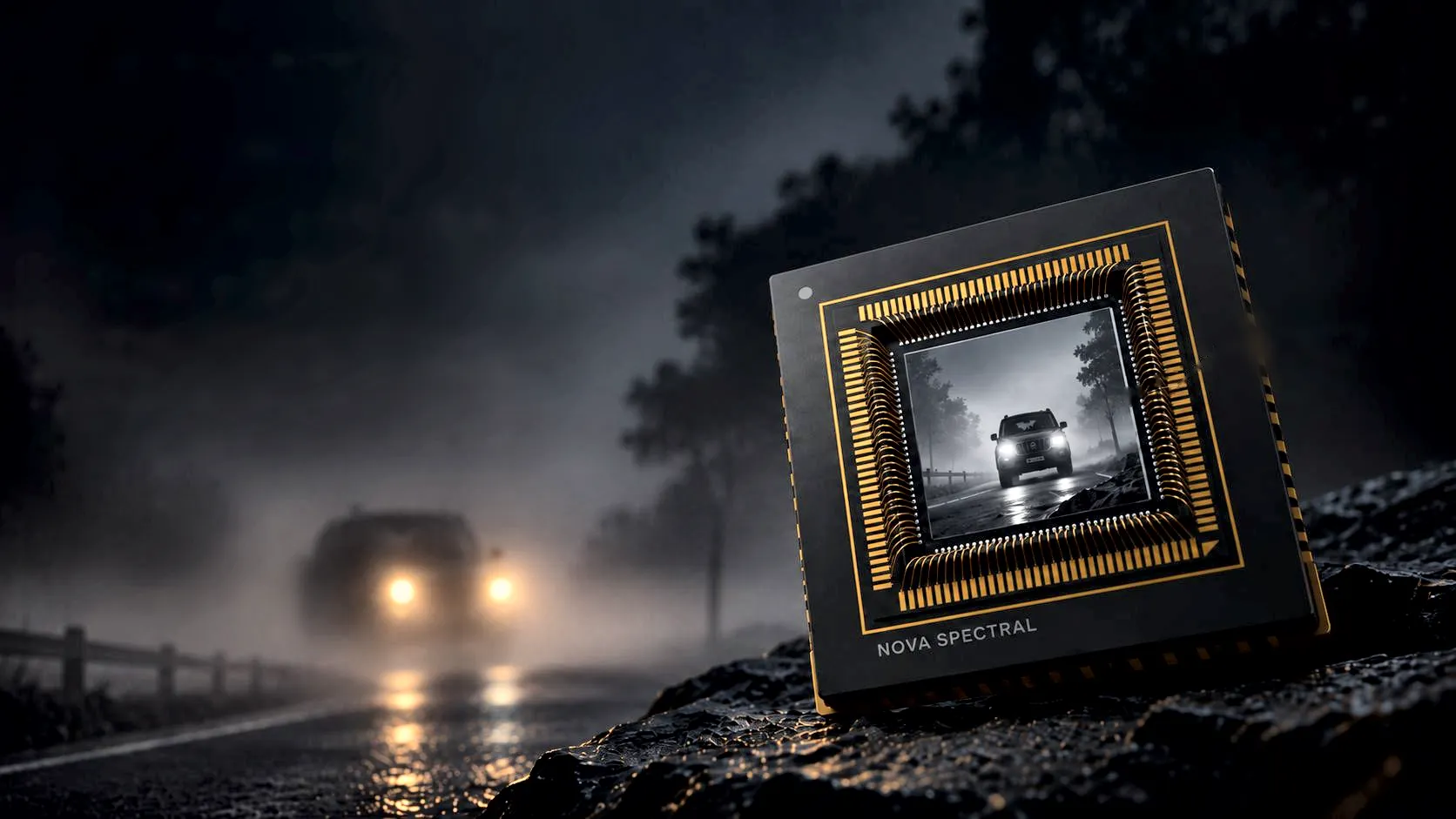
Vision for Physical AI
We're building affordable, indigenous SWIR image sensor chips — lead-free Indium Arsenide (InAs) colloidal quantum dots (cQD) on silicon CMOS — so every machine can see, and act, beyond visible light.
Drones, robots and autonomous systems are moving into the real world, where conditions are unforgiving and the cost of failure is high.
SWIR imaging can see at night by the faint natural glow of the night sky, and through smoke, haze, dust and light fog. The technology is proven, but today's InGaAs sensors are too expensive to deploy widely. We're developing SWIR sensors on standard silicon CMOS instead, to bring reliable vision, and with it autonomy, to every machine that needs it.
Lab to Fab
From quantum-dot material, to photodiode device, to a CMOS-integrated sensor array.
Development status
Ink & device R&D underway
01 · Stability
Turning InAs cQD into stable, conductive ink.
02 · Uniformity
Coating the ink into smooth, even films across the wafer.
03 · Efficiency
Layers that carry the signal out of the quantum-dot film.
04 · Compatibility
Building the full stack on standard silicon CMOS readout wafers.
2026 In progress
InAs cQD inks and ligand exchange, formulated in-house; photodiode stack development.
2027 Next
Quantum-dot films deposited and patterned directly on CMOS readout wafers; test structures.
2028
Field-ready sensor-array prototype, packaged with specialist partners, and performance validation.
2029
Our own pilot fabrication line; field pilots with defence and ISR partners.
The Thesis
The intelligence is ready. The perception isn't — we're working to make SWIR affordable and indigenous, so every machine can finally see.
Machines can now plan, reason, and act. But every decision rests on what their sensors can resolve — and perception, not intelligence, is now the limit.
Conventional cameras fail in the conditions autonomy can't avoid — darkness, glare, smoke, haze, dust, and light fog. The moments that matter most are the ones they miss.
Shortwave infrared already sees through much of it. But today's InGaAs-based SWIR stays far too expensive to deploy beyond a few high-end systems.
Our First MissionDrishyaTech
SWIR imaging for drones, ISR, and the soldier — being developed in India.
Most infrared detectors in India's night sights, drone payloads, and ISR systems are imported — a critical layer of the imaging chain, and one often subject to export controls abroad. Mission DrishyaTech is our answer: an indigenous SWIR image sensor chip, now in development, for the platforms that must see first, and act with confidence.
Target — Field-ready prototype in 18 months

Applications
Defence is the toughest proving ground, and our first market. The long game is global: a SWIR chip compact, affordable and lead-free enough for the world's leading smartphone, automotive and electronics makers to design into their products.

Situational awareness in darkness, smoke, haze, and light fog.

Airborne perception for navigation, monitoring, and ISR.

Sees through haze and smoke, day and night, and helps expose camouflage.

Sees through haze and spray, and can detect water and ice on the road.

Detects moisture, defects, and material differences invisible to standard cameras.

Under-display face authentication and eye-safe sensing in phones and smart glasses.

Co-founder, CEO & CTO
Previously built a complete colloidal quantum-dot device fabrication and R&D facility from the ground up, and fabricated InAs quantum-dot photodiodes for SWIR imaging across multiple wavelengths. Industry experience in CMOS wafer-scale manufacturing at GlobalFoundries, and at Nanoco. IIT Kanpur; PhD, NTU Singapore.

Co-founder & CBO
20+ years of commercial leadership — go-to-market, P&L responsibility, and building and scaling businesses. IIT Kanpur; IIM Lucknow.
Careers
We're a small team of chemists, device physicists and engineers taking a new kind of image sensor from the lab to the fab, in India. If you want hard problems at the meeting point of materials science and silicon, and work that ends up as a real chip, we'd like to hear from you.
Get in Touch
We welcome conversations with camera and device makers, semiconductor and materials partners, research institutions, and strategic investors.
Device makers, CMOS and materials partners, packaging partners, and research institutions.
partnerships@dhrisyatech.comStrategic and institutional investors.
invest@dhrisyatech.com